Factors, Multiples, Prime and Composite
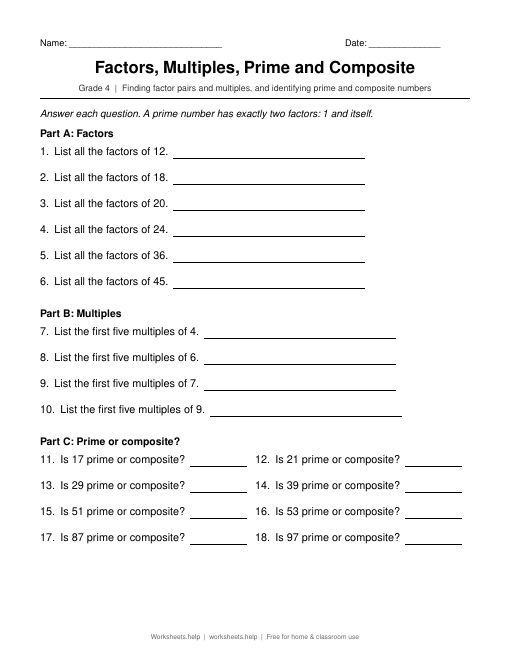
Skill: Finding factor pairs and multiples, and identifying prime and composite numbers
Download PDF worksheetAnswer key (PDF)
Free for personal and classroom use. Print at 100% / "Actual size" on US Letter paper.
About this worksheet
Factors and multiples are closely related ideas that students use constantly in later math, especially with fractions. This fourth-grade worksheet has three parts. In Part A, students list all the factors of six numbers, such as 24 and 36. In Part B, they write the first five multiples of four numbers. In Part C, they decide whether each of eight numbers is prime or composite. All numbers are between 1 and 100.
Some numbers in Part C are chosen because they often fool students. For example, 51 and 87 look like they might be prime, but 51 = 3 × 17 and 87 = 3 × 29. Checking them carefully builds good habits.
How to use it: for Part A, teach students to find factors in pairs. Start with 1 and the number itself, then try 2, 3, 4, and so on, writing each pair as you find it (1 × 24, 2 × 12, 3 × 8, 4 × 6). When the pairs start to repeat, you have found them all. For Part B, remind students that multiples are what you get when you skip count, and the number itself is the first multiple.
The answer key lists every factor and multiple and labels each number prime or composite. This worksheet supports Common Core standard 4.OA.B.4 (find all factor pairs for a whole number from 1 to 100, recognize that a number is a multiple of each of its factors, and determine whether it is prime or composite).
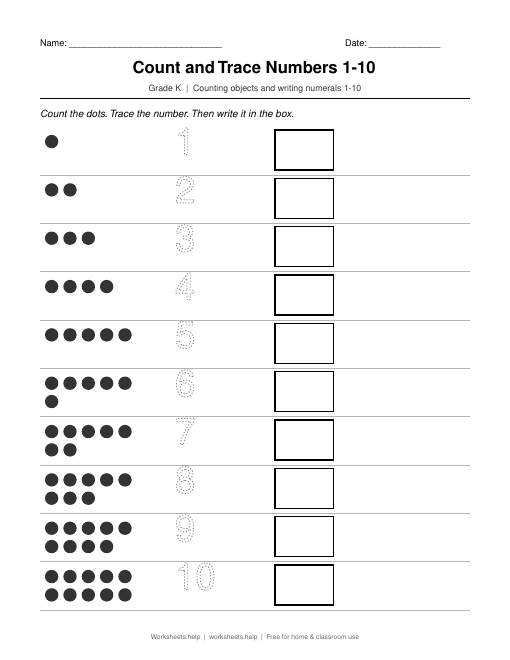 Count and Trace Numbers 1-10
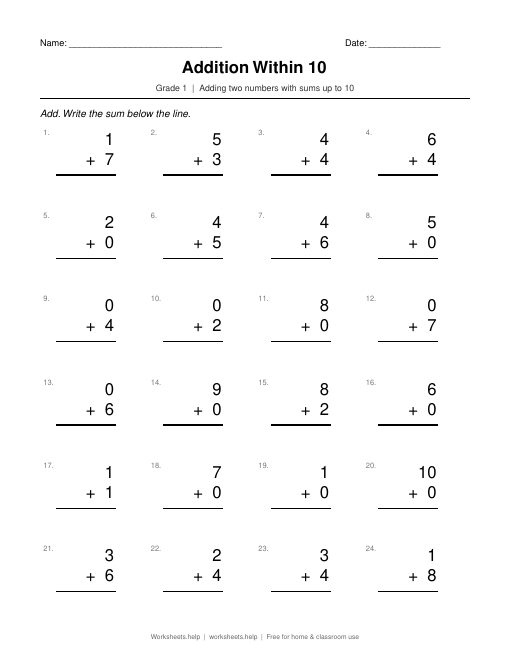 Addition Within 10
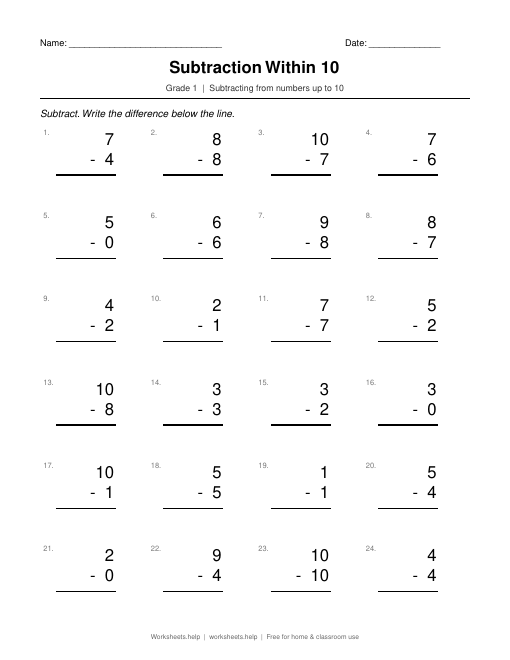 Subtraction Within 10